X-ray binaries - exploring Cyg X-1
Cygnus X-1 is a well-known high-mass X-ray binary located at a distance of about 2.2 kpc, consisting of a black hole and an O-type supergiant companion. It was the first strong black hole candidate ever identified and remains one of the most extensively studied X-ray sources, exhibiting persistent emission powered by accretion from the stellar wind of the massive donor star. Recent observations by Ramachandran et al. (2025) have updated its parameters:
Orbital parameters
Physical parameters of the donor
The following exercises will focus on reconstructing the evolutionary history of Cygnus X-1. The goal is to identify a binary model that reproduces the observed parameters of the system.
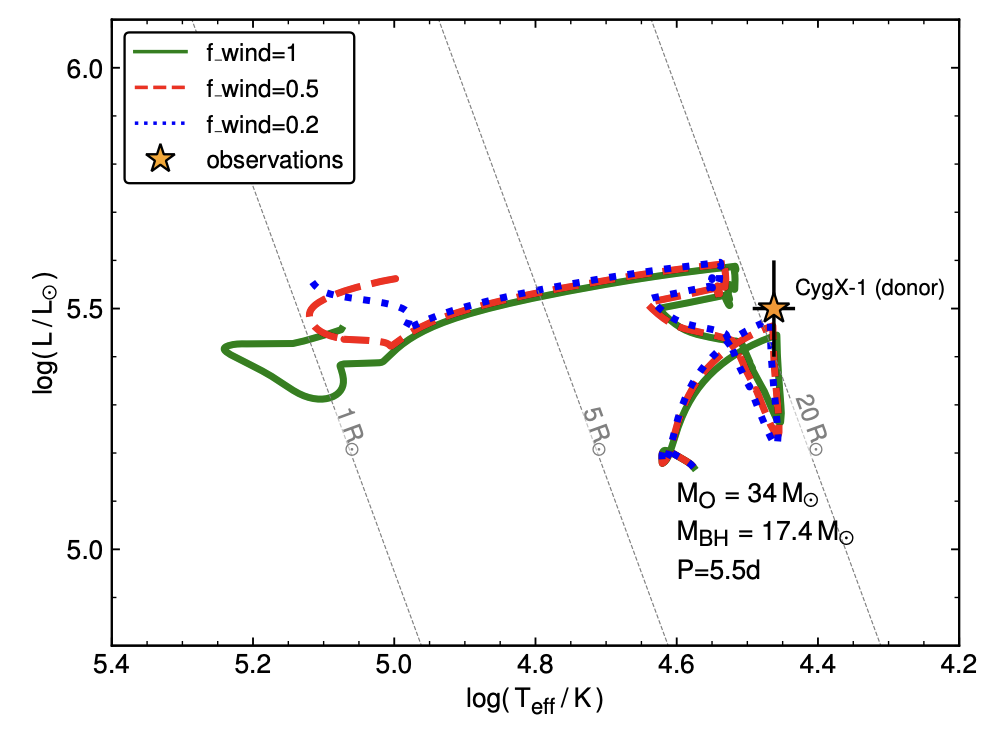
Fig. 1: The HR diagram illustrating the potential evolution of the Cyg X-1 donor star as a product of a black hole (point mass) and a O-type star on the days orbit overlaid on the observed position of the Cyg X-1 donor. The plot displays three models with different mass-loss scaling factors of , and to demonstrate the effect of wind mass loss on evolution (taken from Ramachandran et al., (2025))
Task 1. Simulating the Evolution of Cygnus X-1
To simulate the evolution of Cygnus X-1, we would ideally start off by creating a fresh copy of the work/ directory (cp -r $MESA_DIR/binary/work .) and modifying the inlist files to capture all relevant physical effects leading the initial system to the current form. However, to save time, we will use an already prepared MESA work directory that can be downloaded from here: ⬇ Download
Following Ramachandran et al. (2025), lets start off with setting the initial masses of the components,
and orbital period
in the inlist_project file, designed to contain all information about the system-related quantities. To find the controls used by MESA, look into the MESA docs, under the specifications for starting model section.
Important
Note that the component assigned with index 1 is considered as the donor throughout this lab. Thus, the natural thing is to assign the bigger mass to m1.
Solution
In binary_controls section, add the following lines
   ! Initial parameters of the system
   m1 = 34.0d0  ! donor mass in Msun
   m2 = 17.4d0  ! companion mass in Msun
   initial_period_in_days = 5.5d0  ! initial orbital period
As the secondary component is a black hole, we assume it to be a point mass and focus only on the detailed evolution of the donor. This can be done by setting evolve_both_stars = .false. in binary_job section. Additionally, we need to set a few additional controls on the system:
- the
Kolbmass transfer scheme,
Tip
Look under the mdot_scheme control in MESA docs
Solution
mdot_scheme = "Kolb" - do the wind mass accretion from the donor to the BH
Tip
Look under the do_wind_mass_transfer_1 control in MESA docs
Solution
do_wind_mass_transfer_1 = .true. - assume conservation of the total angular momentum of the system, including loss of angular momentum via mass loss and via gravitational wave radiation
Tip
Explore the do_jdot_* controls in the MESA docs to find the relevant controls.
Solution
   do_jdot_ml = .true.  ! mass loss
   do_jdot_gr = .true.  ! gravitational wave radiation
do_jdot_ls = .true. ! assume LS coupling due to tides- involve the effects of tides when following the evolution of stellar rotation
Tip
In MESA we enable per-component rotation, in the inlist1/inlist2 files, under star_job using
     ! rotation
     new_rotation_flag = .true.
     change_rotation_flag = .true.
     change_initial_rotation_flag = .true.
But we have that in our inlist already! If we want to account for the tidal effects in the evolution of stellar rotation, we need to include do_tidal_sync in the inlist_project file.
To see if all runs well, compile (./clean && ./mk) and run your new model! (./rn). This is only to check if we set all the controls correctly, so kill the run after a few timesteps using Ctrl C.
Task 1.1. Finding the model that fits the observations
Based on the parameters obtained by Ramachandran et al., (2025) (see the introductory part of this lab), we can try and find the model that fits within the measured stellar parameters, like , and , and terminate the computations after doing so.
To force MESA to stop after finding a fitting model to the observations, we need to modify the run_binary_extras.f90 file. You can find it in the src/ inthe working directory. We have already prepared the file, so all you need to do is to capture the MESA quantities and to compare them with observed parameters. One of the ways is to use the observed uncertainties and to compare them with the MESA parameters:
    if ( abs(Teff_MESA - Teff_obs) < dTeff_obs) then
        ...
    end if
As we want to capture not only but also other stellar quantities, we need to expand the above example a bit.
Go ahead and add a stopping criterion extras_binary_finish_step = terminate in the extras_binary_finish_step function once a model reaches all of the desired surface properties (
,
, and
). Focus only on the TASK 1.1 part in run_binary_extras.f90 this time.
Tip
In the very beginning of the run_binary_extras file, we have already initialised some variables to address the observed parameters of the system:
   ! Global parameters of Cyg X-1
   real(dp), parameter ::  Teff_obs = 28500.0d0,  logL_obs = 5.5d0,  logg_obs = 3.2d0
   real(dp), parameter :: dTeff_obs =  1000.0d0, dlogL_obs = 0.1d0, dlogg_obs = 0.1d0
You can use these when comparing with the MESA quantities.
Important
You can use the quantities internally computed by MESA using the binary pointer b% and star pointers s1%/s2% to acccess the donor/accretor modules, respectively. Some examples of useful values are:
b% s1% Teff: The stellar effective temperature of the primary.b% s1% photosphere_L: The stellar luminosity of the primary.b% s1% photosphere_logg: Logarithm of the stellar surface gravity of the primary.
Tip
You can instruct MESA to stop computations by using extras_binary_finish_step = terminate at the right place.
Solution
    integer function extras_binary_finish_step(binary_id)
        ...

         ! TASK 1.1
         ! Spectroscopic observations:
         !     Teff  = 28500 +/- 1000 K
         !     log_L = 5.5 +/- 0.1 Lsun
         !     log_g = 3.2 +/- 0.1
         !
         ! Apply a terminating condition, after we find a model fitting within the observed parameters
         if ( abs(b% s1% Teff - Teff_obs) < dTeff_obs .and. &
              abs(log10(b% s1% photosphere_L) - logL_obs) < dlogL_obs .and. &
              abs(b% s1% photosphere_logg - logg_obs) < dlogg_obs) then

              write(*,*) "Found a model maching the observations. Terminating"
              extras_binary_finish_step = terminate

        end if

    end function extras_binary_finish_step
Note
Modern Fortran allows up to 132 characters per line. If you want to break the line, use an ampersand &.
Bonus task
Bonus task!:
The above example was coded to terminate after finding the model that fits within the observations. As you may suspect, this model is not necessarily the only one, nor the best one to fit the observations. If you finished your assignments early, try to find the best model by applying some kind of a statistics, like
. You will need to define the chi2 function outside of the run_binary_extras.f90 main body, and call it before and after MESA calculates another step. You can find the places in run_binary_extras.f90 that need some extra attention marked with a ! part of the bonus excercise note. Good luck!
Tip
For simplicity, we can assume that the have only one minimum between the models. This is, of course, a very naive approach as the evolutionary calculations are an extremely degenerate problem!
To be able to compare the value of the between the models we need to store them across the calculations. The best (not the easiest, though) way would be to construct a table and to store the values of in it. However, the assumption that has only one minimum allows us to store the from only the previous step and to compare it with the current-step value. If then we have yet to reach the minimum, and there is still place for improving the fit between the observation and the model. Once we find the first model with we are in the minimum!
This approach requires us to compute two values of
at every step: the value for the previous step and for the current one. Here, the structure of the run_binary_extras.f90 comes extremely helpful, as it contains two functions, extras_binary_start_step and extras_binary_finish_step. The latter updates the parameters of the system evolution after the calculations are done, while the former allows us to access the parameters before them being updated, thus from the previous step. This is the place to call the chi2 function for the first time!
The statistics formula
The formula for the statistics is as follows:
where is the observed value, is the theoretical value (in our case returned by MESA) and is the observed error.
Bonus task solution
Here is the solution to the bonus task.
    integer function extras_binary_start_step(binary_id,ierr)
        ...
        ! part of the bonus excercise
        !
        ! store all spectral parameters, like Teff, logL or logg
        ! from the previous step
        Teff_old  = b% s1% Teff
        logg_old  = b% s1% photosphere_logg
        logL_old  = log10(b% s1% photosphere_L)

        ! Calculate the chi2 statistics on the previous model

        chi2_value_old = chi2(Teff_old, logL_old, logg_old, &
                            Teff_obs, logL_obs, logg_obs, &
                            dTeff_obs, dlogL_obs, dlogg_obs)

        write(*,*) 'Chi2 from the previous step:',chi2_value_old
    end function  extras_binary_start_step

    ...

    integer function extras_binary_finish_step(binary_id)
        ...
        ! part of the bonus excercise
        ! Calculate the chi2 statistics on the current model
        !
        chi2_value = chi2(b% s1% Teff, log10(b% s1% photosphere_L), b% s1% photosphere_logg, &
            Teff_obs, logL_obs, logg_obs, &
            dTeff_obs, dlogL_obs, dlogg_obs)

        write(*,*) 'Chi2 from the current step:', chi2_value


        ! TASK 1.1
        ! Spectroscopic observations:
        !     Teff  = 28500 +/- 1000 K
        !     log_L = 5.5 +/- 0.1 Lsun
        !     log_g = 3.2 +/- 0.1
        !
        ! Apply a terminating condition, after we find a model fitting within the observed parameters
        if ( abs(b% s1% Teff - Teff_obs) < dTeff_obs .and. &
            abs(log10(b% s1% photosphere_L) - logL_obs) < dlogL_obs .and. &
            abs(b% s1% photosphere_logg - logg_obs) < dlogg_obs .and. &
            chi2_value > chi2_value_old) then

            ...

            extras_binary_finish_step = terminate
        end if

    end function extras_binary_finish_step

    ...

    ! Part of the bonus excercise
    ! Create a function calculating chi2 to be called from any place in run_binary_extras
    !
    real(dp) function chi2(Teff_mod, logL_mod, logg_mod, &
                            Teff_obs, logL_obs, logg_obs, &
                            Teff_err, logL_err, logg_err)
        real(dp), intent(in) :: Teff_mod, logL_mod, logg_mod
        real(dp), intent(in) :: Teff_obs, logL_obs, logg_obs
        real(dp), intent(in) :: Teff_err, logL_err, logg_err

        chi2 = 0.0d0
        chi2 = chi2 + ((Teff_mod - Teff_obs) / Teff_err)**2
        chi2 = chi2 + ((logL_mod - logL_obs) / logL_err)**2
        chi2 = chi2 + ((logg_mod - logg_obs) / logg_err)**2
    end function chi2
Important
Extra bonus task!: We have an extra bonus task for you that explores stopping criteria and fitting a model for yet another observed system! You can find it here .
Warning
Take a look at this exercise only once you have finished all the parts below!
Caution
Got stuck during the lab? Do not worry! You can always download the solution from here ⬇ Download to catch up!
Task 1.2. Gravitational wave radiation and merger time

Fig. 2: An artist’s impression of gravitational waves in an inspiralling binary system (Credit: Caltech-JPL. R. Hurt).
Once we are all set to run our model, we can add one extra tweak to our computations. As we already assumed and implemented the loss of angular momentum via gravitational waves radiation in our model (the do_jdot_gr control in the inlist_project file), we can compute the approximate time our binary will take to merge.
For two point masses and on a circular orbit with separation , the GW inspiral time (Peters 1964) is given by
Alternatively, using orbital period instead of orbital separation:
where is the chirp mass:
Note
The choice between and is immaterial, as both quantities are equivalent and directly related through Kepler’s law; specifying one uniquely determines the other for a given system. Here, we propose to implement the equation using .
We need to do this once MESA has updated all the system parameters, thus in the extras_binary_finish_step function. We have two choices: we can force MESA to compute the merge time on a fly at every step, to be able to see how the merge time depends on the orbital period and the distribution of masses between the components, or we can implement this chunk of code inside the if statement of the previously implemented stopping criterion. As we are primarily interested in knowing the merge time at the current phase of the evolution, we can choose the second option.
Note
MESA computes all we need under the hood. All we need to do is to capture all required quantities from MESA and to compute .
Tip
You can capture the required masses and orbital period using pointers, with b% m(1), b% m(2) and b% period. The constants, as the speed of light
, the gravitational constant
or the approximate value of
can be accessed from the const_def module (inside const/public/const_def.f90 file).
Hint
The scaffolding of where the gravitational wave calculations should be done
      ! returns either keep_going or terminate.
      ! Note: cannot request retry; extras_check_model can do that.
      integer function extras_binary_finish_step(binary_id)
         type (binary_info), pointer :: b
         integer, intent(in) :: binary_id
         integer :: ierr

         ! Initialise new variables
         ! GRAVITATIONAL WAVES EMISSION PART
         ! real(dp) :: mchirp, t_merge, t_merge_gyr

         call binary_ptr(binary_id, b, ierr)
         if (ierr /= 0) then ! failure in  binary_ptr
            return
         end if
         extras_binary_finish_step = keep_going


         ! TASK 1.1
         ! Spectroscopic observations:
         !    Teff  = 28500 +/- 1000 K
         !    log_L = 5.5 +/- 0.1 Lsun
         !    log_g = 3.2 +/- 0.1
         !
         ! Apply a terminating condition, after we find a model fitting within the observed parameters
         ! if(...) then

             ! GRAVITATIONAL WAVES EMISSION PART
             ! Now that we have found the quasi-best fitting model, let's compute the merger time due to GW
             ! emission, based on Peters 1964
             !     From MESA lib: b% m(1) and b% m(2) are in grams, b% period is in seconds,
             !     const_def gives Msun, clight and standard_cgrav in cgs

         ! end if

      end function extras_binary_finish_step
Important
Remember that MESA lib (i.e. the internal library of MESA that allows direct access to stellar and binary model data during runtime) gives b% m(1) and b% m(2) in grams and b% period in seconds. Constants, such as
standard_cgrav are in cgs. If you want to use the MESA-computed constants, remember that the const_def module needs to be imported (it is by default) at the beginning of the run_binary_extras.f90.
Solution
    ! Initialise new variables
    ! GRAVITATIONAL WAVES EMISSION PART
    real(dp) :: mchirp, t_merge, t_merge_gyr

    ...

    ! Chirp mass
    mchirp = ((b% m(1) * b% m(2))**(3.0d0 / 5.0d0)) / ((b% m(1) + b% m(2))**(1.0d0 / 5.0d0))

    ! t_merge in seconds
    t_merge = (5.0d0 / 256.0d0) * (clight**5 / standard_cgrav**(5.0d0 / 3.0d0)) * &
                ((b% period / (2.0d0 * pi))**(8.0d0 / 3.0d0)) * mchirp**(-5.0d0 / 3.0d0)

    ! seconds to Gyr
    t_merge_gyr = t_merge / (3600.0d0 * 24.0d0 * 365.25d0 * 1.0d9)

    write(*,*) 'Merger time [Gyr]  = ', t_merge_gyr
To apply all the changes you have made in your run_binary_extras.f90, you need to compile (./clean && ./mk) and run your model (./rn)!
Caution
Got stuck during the lab? Do not worry! You can always download the solution from here ⬇ Download to catch up!
Task 2. The efficiency of mass transfer and its impact on the evolution of Cyg X-1
Mass transfer in close binary systems is a highly complex, multidimensional process shaped by hydrodynamic interactions, angular momentum exchange, and geometry-dependent flow patterns. Rather than a smooth and complete handover of mass from one star to the other, the gas is channeled through the inner Lagrangian point, forming a stream that enters the Roche lobe of the companion. Depending on the relative size and position of the stars, this stream may directly impact the accretor or settle into an accretion disk before any material is finally incorporated. A significant portion of the transferred matter might never reach the companion at all, being expelled from the system via outflows, disk winds, or loss through the outer Lagrangian points.
Capturing the full physics of this process requires 3D hydrodynamical simulations, which remain computationally expensive and inaccessible for 1D routine stellar evolution modeling. In the context of 1D codes like MESA, we therefore adopt simplified prescriptions that approximate the outcome of these processes through parameterized treatments.
A central parameter in such models is the accretion efficiency, which describes the fraction of the donor’s mass loss that is successfully accreted by the companion. MESA implements this through a set of &binary_controls parameters:
mass_transfer_alpha- fraction of mass lost from the vicinity of donor as fast wind ! (e.g., isotropic re-emission)mass_transfer_beta- fraction of mass lost from the vicinity of accretor as fast windmass_transfer_delta- fraction of mass lost from circumbinary coplanar toroidmass_transfer_gamma- radius of the circumbinary coplanar toroid is ! “gamma**2 * orbital_separation”
The effective accretion efficiency is given by:
In this minilab, we will investigate how the choice of these parameters — particularly beta, which reflects wind loss near the black hole — influences the binary’s orbital and stellar evolution. We will adopt the default values of mass_transfer_alpha = 0d0, mass_transfer_delta = 0d0, and mass_transfer_gamma = 0d0 throughout, and explore a range of values for mass_transfer_beta to assess the impact of inefficient accretion in systems like Cygnus X-1. This will allow us to test how different mass loss scenarios shape the long-term configuration of the system.
Task 2.1. Varying the Mass Transfer Efficiency
To explore the effect of mass transfer efficiency on the future evolution of Cyg X-1, we will vary the efficiency of mass transfer by changing the mass_transfer_beta parameter while keeping the initial primary masses and orbital period fixed, as we did before. As each run may take a while, we will crowd-source this!
The participants should split into groups that will be assigned different values of mass_transfer_beta and limit_retention_by_mdot_edd, which is a control for the Eddington limited mass-accretion rate. To do so, please write your name in the following Google Spreadsheet (local copy; navigate to Lab2 Mass Transfer Efficiency tab in the lower-left corner if needed) to select a
value, from 0.0, 0.1, 0.2, 0.3, 0.4, 0.5, 0.6, 0.7, 0.8, 0.9, corresponding to accretion efficiencies from 100% up to 10%, respectively. These values come either without the Eddington limit (by default) or with Eddington Eddington-limited mass-accretion rate. If you choose the latter, remember to include limit_retention_by_mdot_edd = .true. in your binary_controls section!
Note
Do not change the initial masses or period. Focus only on the effect of beta. If you have a slower machine (with a lower number of cores), choose a lower as these runs tend to be faster. Faster machines can attempt higher beta values, which lead to more computationally demanding models. The run should take approximately 5 minutes on 2-core machines, while the run needs around 10 minutes.
As the model fitting within Cyg X-1 determined parameters is right on the onset of mass transfer, let us comment out the previously applied stopping criterion from the run_binary_extras.f90 to let the system evolve a bit further. This time, let us choose the stopping criterion based on the minimum mass of the donor set to
. As MESA already has a command telling it to finish a run after such a condition is met, we do not need it to be implemented inside the run_binary_extras.f90. Instead, as the limit of mass applies only to one of the components, we need to include this condition in the inlist1 file. Explore stopping conditions in the MESA docs to find the right command.
Solution
   &controls
      ...
      ! stop when mass drops below this limit
      star_mass_min_limit = 23.0d0
To make the runs a bit faster, reduce the resolution to
   &controls
   ...
      ! resolution
      mesh_delta_coeff = 2.0d0
      time_delta_coeff = 2.0d0
Note
For actual research, the models need to be resolved as accurately as possible. The trick described above is intended for training purposes only!
The last step is to compare the merge time with the one we got in the previous step. Modify slightly the run_binary_extras file, as we no longer need to calculate the merge time only for the specific model - let it be calculated for every model to see whether this value changes. Add the resulting merge time of the last computed model, when the donor reaches the minimum mass which terminates the run, to the Google Spreadsheet in the column next to your name under the selected case.
Next, compile (./clean && ./mk) and run the models (./rn) with a fixed set of initial parameters (donor and black hole masses, and orbital period), while exploring different values of mass_transfer_beta. This isolates the role of accretion efficiency in shaping the orbital evolution, mass growth, and observable properties of the system.
Important
As a group effort:
What can we say about the future evolution of Cyg X-1 system from varying the mass_transfer_beta alone? How does the orbit react and why?
Should the merge time differ from the previous step, and why is that so?
To think about:
Is mass_transfer_beta the only way to control the accretor mass outcome? Can we substitute this parameter with another parameter that MESA provides, e.g., lowering the initial mass of the donor component? Why?
Caution
Got stuck during the lab? Do not worry! You can always download the solution from here ⬇ Download to catch up!
Important
Extra bonus task!: We have an extra bonus task for you that explores stopping criteria and fitting a model for yet another observed system! You can find it here .